Blog / Smoothie guides
Milk or Water in Smoothies? How to Choose Your Liquid Base
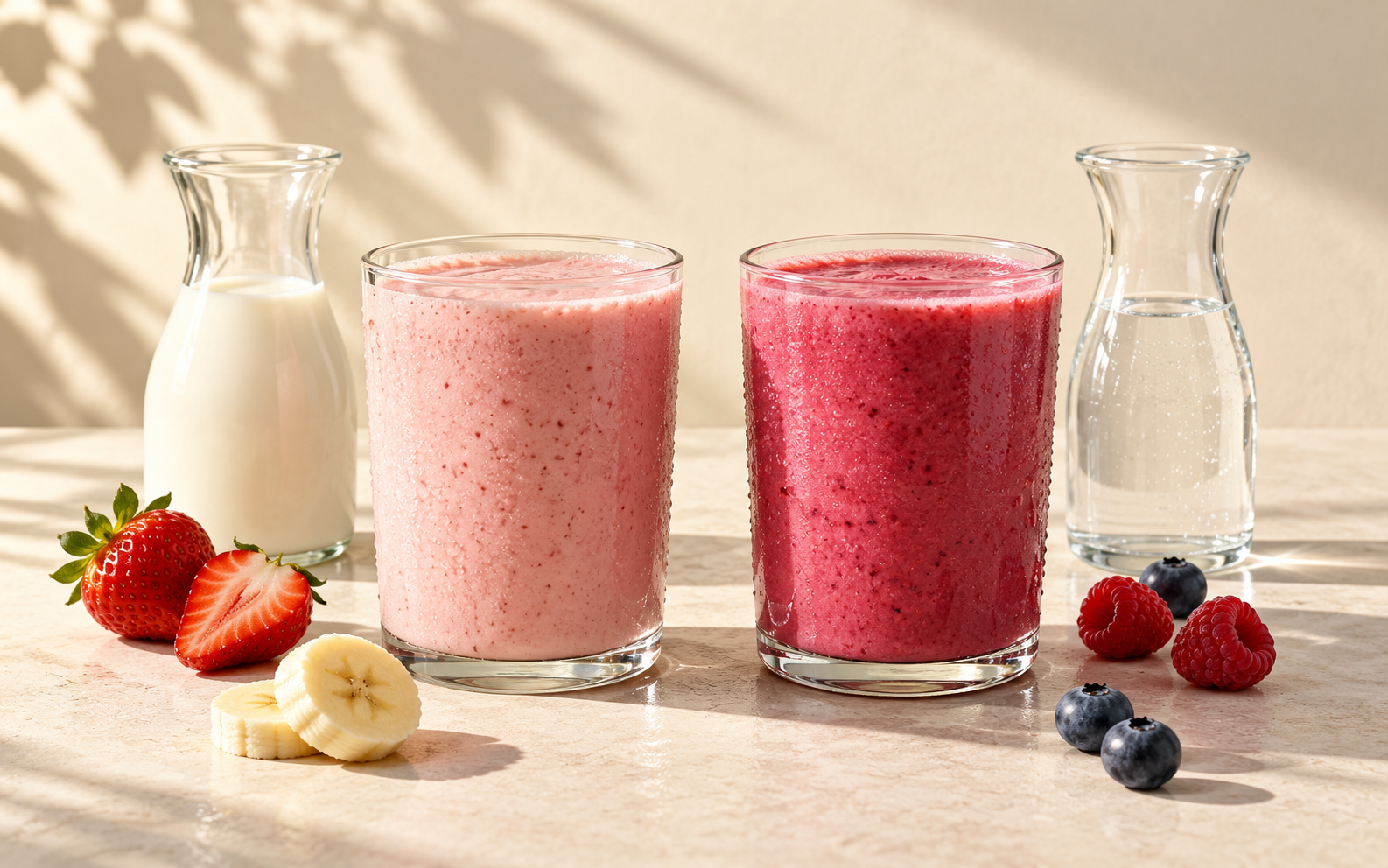
Milk or water for smoothies? Either can work. Water gives a lighter smoothie that lets the fruit lead; milk gives a creamier, fuller one. If you're using a ready-to-blend pack, start with the liquid in its directions, then change it only if you have a reason to, such as taste, texture or a dietary need.
Here's how the most common liquids compare, and which one each Gulp pack uses.
Can you make smoothies with water?
Yes. Water is the simplest base: it adds no flavour of its own, so the fruit stays front and centre, and it keeps the texture light.
Gulp's directions use water for Berry Best, Mango Glow and Beet Bliss: 150 ml water and ice each. Berry Best and Mango Glow already contain yoghurt, and Beet Bliss contains almond butter, so there are creamy ingredients in the pack itself.
Dairy milk
Dairy milk makes a smoothie creamier and fuller-tasting, and it rounds out stronger flavours such as coffee, cocoa and peanut butter.
Gulp's directions use milk for Peanut Oat, Choc Nut and Coffee Blast (150 ml milk and ice), and for Tropical Green (150 ml milk, ice and 1 tsp honey).
Remember that dairy milk is itself an allergen (cow's milk).
Plant-based milk
Plant-based milks, such as almond, oat, soya or coconut milk drinks, vary a lot in flavour, sweetness and thickness. Unsweetened versions tend to be the most neutral; others add sweetness or a nutty taste.
Gulp's Peanut N Berry directions use 100 ml almond milk with 100 ml water and ice. Almonds are tree nuts, so the almond milk adds a tree-nut allergen even though the Peanut N Berry pouch itself declares only peanuts.
Where Gulp's directions say "milk", they don't name a type. If you use a plant-based milk instead, expect the taste and texture to be a little different from the original directions.
Coconut water
Coconut water is thin, like water, with a light, slightly sweet coconut taste. Gulp's Citrus Fix directions use 150 ml coconut water and ice, alongside the pack's orange, banana, yoghurt and dates.
Quick comparison: flavour and texture
Water: neutral flavour that lets the fruit lead; the lightest texture.
Dairy milk: creamy, mellow flavour; a richer, fuller texture.
Plant-based milk: anything from neutral to nutty or sweet, depending on the type; texture ranges from thin to creamy.
Coconut water: light and slightly sweet; a thin texture, similar to water.
Which liquid does each Gulp pack use?
150 ml water and ice: Berry Best, Mango Glow, Beet Bliss
150 ml milk and ice: Peanut Oat, Choc Nut, Coffee Blast
150 ml milk, ice and 1 tsp honey: Tropical Green
150 ml coconut water and ice: Citrus Fix
100 ml almond milk, 100 ml water and ice: Peanut N Berry
Start with these, then adjust the texture with small splashes of the same liquid.
Check both the pack and the liquid
If you have an allergy or dietary need, check two things: what's in the pouch, and what you're adding to it.
The pack's ingredients don't change. Berry Best, Peanut Oat, Mango Glow and Citrus Fix all contain yoghurt, and their declared allergens include cow's milk. Blending them with water or a plant-based milk doesn't make them dairy-free.
Your liquid can add allergens. Dairy milk adds cow's milk; almond milk adds tree nuts. Plant-based milks can carry their own allergen information, so read the label.
Extras count too. Honey, for example, is something you add to Tropical Green; it isn't in the pack.
Gulp's allergen information covers the frozen pouch only. Each product page lists the ingredients, declared allergens and directions; browse the range to compare them.
So, milk or water?
Choose water for a lighter, fruit-forward smoothie, milk for something creamier, and a plant-based milk or coconut water when you prefer their flavour or want to avoid dairy in your liquid, remembering that the pack itself may still contain dairy. Not sure what to use with a particular flavour? Ask us on WhatsApp.